A Biased Review of 4 Different Rappel Backups (Prusiks)
The humble prusik. Perhaps the only piece of climbing gear with the highest function to cost AND function to weight ratio. I believe every climber should carry at least two on any pitch of outdoor climbing, one for you and one for your partner (and maybe a third, just in case). Often made with a piece of accessory cord tied together with a double fisherman’s knot, there seems to be little room for innovation or improvement. However, fear (k)not, for modern material science has afforded us previously never before thought of advancements to the simple prusik loop. I have collected myself a small collection of various contemporary prusik loop offerings and alternatives which I was recently lucky enough to be able to try and compare all at once on a multipitch with dear friends of mine. To create some semblance of a control variable, my rappel setup was otherwise unchanged on the rappels (extended, double strand rappel using a Kong Gigi and Petzl Attache carabiner, with the prusik loops tied using an autoblock hitch). Below are various thoughts on the four options I had with me that day: the Simond Autoblock knot loop, Sterling Hollowblock, Grivel Magic Ring, and Petzl Shunt.
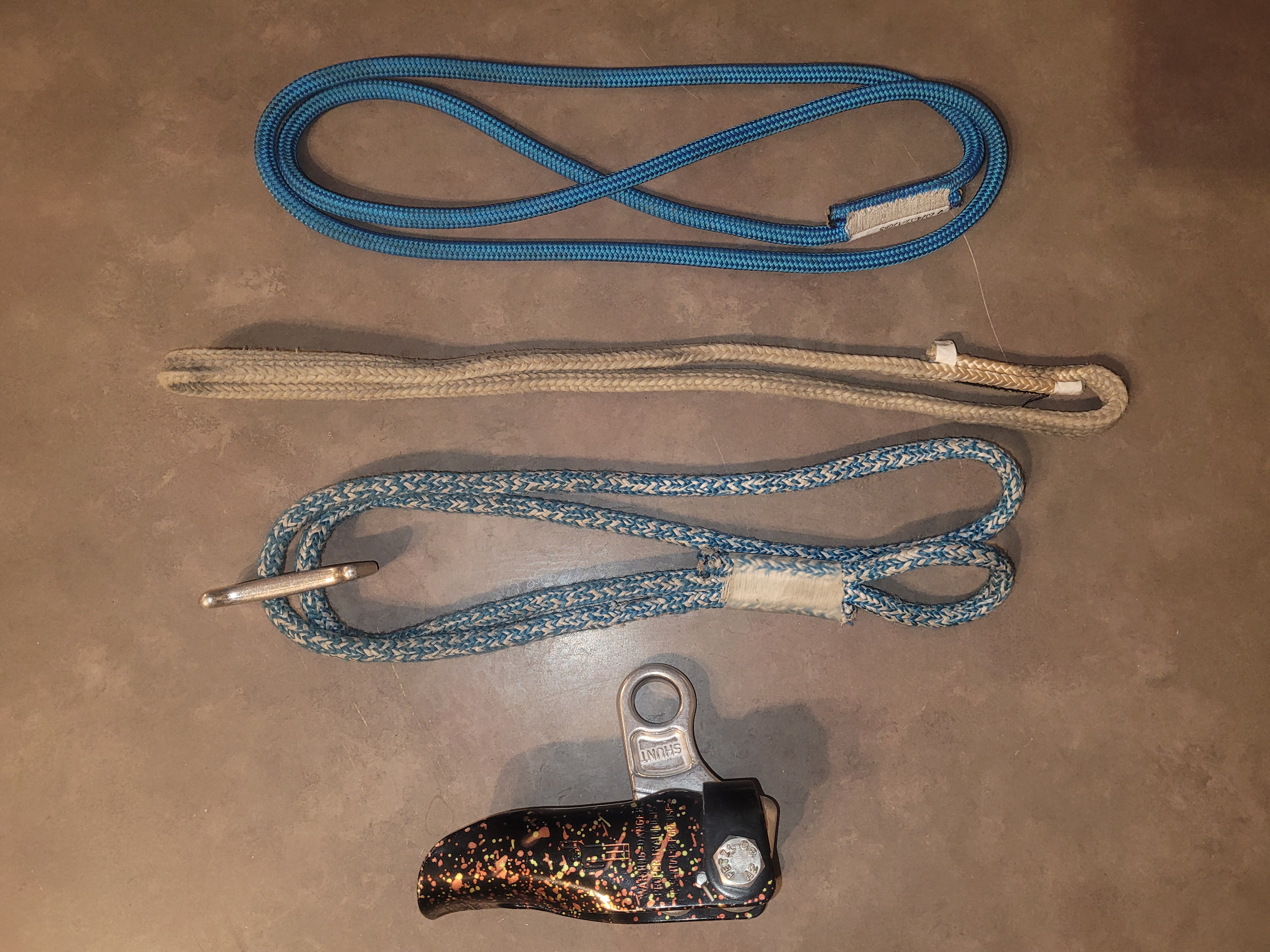
From top to bottom: Simond Autoblock, Sterling Hollowblock, Grivel Magic Ring, Petzl Shunt
Simond Autoblock Knot Loop
The Simond Autoblock (or Autolok) is the cheapest of the following 4 options at $16CAD, and arguably the simplest. It takes the original form of a tied loop of cord to its logical conclusion in an era of strong, light, and thin fibers: a 60cm sewn loop prusik rated for a full 22kn. This means this prusik can be used in lieu of a sling should you ever run out or damage other material for anchor building, rappel extending (you did bring two prusiks, right?), or anywhere else you wanted a rated piece of cord between you and the ground. But the most important question is: how well does it work as a rappel backup? My largest issue with the Simond Autoblock was it’s smooth, slippery sheath. Out of the 4 it had the most trouble grabbing the rope. In addition, the extra length of this prusik loop made it such that I needed to wrap it at least 4 times till it was at a manageable length away from my belay loop. At times, the extra wraps made it hard to keep well dressed, which also contributed poorly to it’s grabbing power.
- It is also worth noting that the stitching on this loop comes covered with a soft rubber casing (like many other sewn prusiks of this type, including but not limited too the Beal Jammy, Sterling Hollowblock, and Grivel Magic Ring) which I cut off on my own personal climbing gear as I have seen increased wear over the point which the fibers bend over the plastic. I have found that cutting this plastic casing off (carefully!!) reduces this issue greatly. Both the next two prusik loops have this same “issue” and I cut both off. This is not recommended by the manufacturer.
Sterling Hollowblock
The Sterling Hollowblock is the most recent prusik alternative I acquired and I was excited to try it out after hearing much good news about it, but honestly I was a little disappointed. The gimmick of the Hollowblock is that it has a hollow core (hence the name) and as such has an easier time grabbing the rope. I found this to be somewhat true, grabbing the rope more easily with less wraps. It was also very easy to release smoothly under load, avoiding the “dropping” sensation of releasing a very grabby prusik. However, due to it’s hollow core the Hollowblock is not rated to a full 22kn and has a lower durability compared to other options. While admittedly feeling very nice and soft in the hand, it’s price (nearly $45CAD) and lack of other features left me with a sour taste. To me this seems like a piece of gear that I would need to spend more money on, and more frequently, than other options. I did not purchase this specific Hollowblock, but for now I can say I will not replace it when it wears out.
- As another small gripe, I personally find Hollowblocks to look quite grungy when used frequently, and even with my few raps on this climb I noticed a significant amount of visual wear on the prusik.
Grivel Magic Ring
The Grivel Magic Ring innovates upon the idea of a prusik by interrogating not the material used, but the method of attachment to the harness. The Magic Ring boasts an aluminum toggle and interesting sewing that allows for the prusik to be attached to the harness without a carabiner. At ~$35-50CAD it is the priciest prusik on this list (depending on where you purchase it, and not including the Petzl Shunt, but I’ll get to that in a minute) but I personally think the price is worth it. The 6mm prusik is fully rated for 22kn (though the sewing means it is slightly less versatile than the Simond option) and it is by far the grippiest cord based prusik on this list. I have used this prusik on much more than this one climb and find that it reliably grabs ropes with only two wraps, and is plenty smooth while rapping and easy to release under load (though admittedly not as smooth or easy as the Hollowblock). The toggle could also be reused when the cord wears out, meaning your rack can continue to stay one carabiner lighter for many climbs to come (I am not sure the manufacturer recommends this, but I will be doing it when the cord wears out). The toggle is surprisingly secure (I was not able to get it out when loading it with bodyweight in a safe environment) and it is honestly just fun and novel to use. I look at the high cost as the cost of toggle, with a nice sewn prusik loop thrown in. If I were to spend too much on a prusik, I would pick the Magic Ring over the Hollowblock any day.
Petzl Shunt
The Petzl Shunt is a lever arm rope clamp designed to be used a rappel backup. Its price can vary and I had some difficulty finding one (I got mine second hand for $40CAD) but new they go for around ~$100CAD. This mechanical rappel backup is bombproof, being designed for industrial rope access, and thus the heaviest option on this list (118g compared to 47g of the Magic Ring, the second heaviest option). This durability also comes with interesting other applications, such as ascending (yes you can do it with a regular prusik but it’s not very fun) and self belay (not recommended by manufacturer). I bought it with the purpose of using it for top rope soloing winter ice routes as it’s large cam grabs icy ropes better than a microtraxion, but am growing to like it for rappelling. It feeds very smoothly in both directions, locks up quickly, and seemingly could be climbed on for generations without wearing out. I have only two gripes about this device. When setting up a rappel I normally like to attach a prusik first, pull up some slack, and have the prusik hold the dead rope weight to make feeding the strands of rope through my belay device easier however, the smooth, bidirectional feeding of the Shunt meant that it did not hold up the rope weight effectively, making it just slightly more annoying and difficult to set up a rappel. In addition, the carabiner I was using to attach the Shunt to my harness got crossloaded very easily. Whether a fault of the carabiner or the device is hard to say, but in the future I will certainly be using an anti-crossload carabiner of some sort.
Conclusion
Are these options more expensive than a tied loop of cord? Yes. Are they more versatile? Sometimes. Are they fun? Yes. Should you buy them? Only if you want to. I love trying out new gear and experimenting with systems, so I am glad I have these prusik options. Personally, I think the Magic Ring wins out of the 4 for simplicity and function, though I am sure practice with the Shunt would let me like it more, and the Simond sling-cum-prusik is cheap and useful. The smoothness of the Hollowblock does not intrigue me more than the additional functions of the other 3. My final tip is replace your chalk bag belt with prusik cord, that way you always have one extra in case you need it (the amount of a piece of gear you need is always n+1 where n is how many you currently have).