Crime and Conflict on Calgary's LRT: A Risk Society Perspective
Calum Munday
Mount Royal University
Dr. Wanda June
2026-02-26
Abstract
This paper conducted an ethnographic research study on the Calgary LRT system looking for incidences of social conflict. The study lasted a period of five weeks and resulted in 98 events being recorded. The data was analyzed with a contemporary risk society lens. The findings identify instantiations of risk society thinking in the methods currently used by the City of Calgary to control conflict on the LRT system. The risk society lens provides support for the decoupling of risk ideology from individuals to look for structural criminogenic factors that can affect offender's rates of recidivism. This shift in focus allows for the identification of shared and structural criminogenic needs that, if addressed, would ameliorate rates of conflict on the transit system. This paper also identifies a need for further research into why current social supports are insufficient to ameliorate the issue of social conflict on transit.
Table of Contents
Crime and Conflict on Calgary’s LRT: A Risk Society Perspective 4
Public Behaviour/Bylaw Infractions 17
Harassment (Verbal & Physical) 19
Dynamic Risk and the Transformative Risk Subject 25
The Decoupling of Risk From the Individual 28
Non-individual Criminogenic Risk Factors Preset in the Data 29
Crime and Conflict on Calgary’s LRT: A Risk Society Perspective
In Calgary there is a standing belief that public transit is rife with conflict and is therefore not preferable or realistic as a mode of daily transportation. A survey from the Calgary Police Commission (CPC) found that of the respondents, 57% believed that there was an observable increase in drug use, vandalism, and violence, all factors identified in an Edmonton transit study as factors that greatly impact perception of safety on transit (Calgary Police Commission, 2025; Kapatsila & Grisé, 2025). It should be noted that these perceptions are just that: opinions of those who are influenced by friends, family, rumors, and social media. Looking at recent crime statistics posted by StatsCan there seems to be an opposite trend in place; crime rates (measured in terms of incidents per 100,000 people) are down across most offenses in Calgary and crime severity—an index that tracks both the amount of a crime reported by police and the relative seriousness of said crimes—has also dropped in recent years (Statistics Canada, 2025b; Statistics Canada, 2025a). There is a clear gap between the data and public opinion regarding crime and conflict on transit. This study will attempt to bridge this gap by considering the instances of crime and non-criminal social conflict on the Calgary LRT using ethnographic research.
In exploring this topic, I begin with a literature review looking at the history and development of transit and the definitions, causes, and interpretations of social conflict. An argument is made supporting the use of the term “social conflict” in lieu of “crime” or “disorder” due to it’s increased ability to capture a wide range of conduct. Methods of research are discussed covering the structure of this ethnography, limitations, how the data regarding each instance of social conflict was collected, and ethical considerations. In the results section I discuss the categories of social conflict I witnessed and justified the coding for each instance into their respective categories. I also present a heatmap visualizing where the conflicts occurred, and at what intensity. The data is then considered through a contemporary Risk Society lens and discusses the efforts made by The City of Calgary to mitigate this social conflict. Using Hannah-Moffat’s conception of decoupled, dynamic conceptions of risk I discuss how this framework can help justify more fulsome social supports for those suffering from drug abuse. In addition, I advocate for supporting a decoupled approach to understanding individual’s risk of committing social conflict in future inquiries. The central idea resultant from this discussion is the need to consider risk in a wider context to include non-individual crimingenic risk factors. This research will ideally help shape future transit development in Calgary such as the Red Line LRT south extension and the proposed Green Line and provide an point of entry for discussions about which unmet criminogenic needs should be prioritized with the intent of reducing social conflict on the LRT system.
Summary of Key Literature
Evolving from small ferries used to cross rivers in medieval times, to horse drawn carriages, omnibuses, and trams, to modern trains, trams, and buses, public transit has existed in some form for centuries (Vuchic, 2007). As the industrial revolution took over and supplies for large scale development became abundant, mass transit systems began to form in cities to offer residents an accessible and easy way to make their way around their city, and in turn cities began to be shaped by the availability of said transit (Knowles, 2006). Public transit makes accessible densely packed urban downtown areas allowing for more efficient land use, which is agreeable to developing a more robust economic center, reduction in air and noise pollution, and many other intangible benefits for users such as increased feelings of independence, community pride, and the higher potential for future urban redevelopment (Beimborn et al., 1993). Transit is especially important in urban centers as the benefits of transit improvements are disproportionately higher in areas where roadway congestion is common, and the benefits from such transit developments do not diminish should city redevelopment reduce congestion (Beimborn et al., 1993).
The development of light rail transit systems (LRTs)—one of which is the focus of this paper—allowed for rail systems based on more traditional tram technologies to carry more passengers and operate at higher speeds. Edmonton, Alberta was the first city to begin using this new technology in 1972, followed by the Calgary LRT in 1982 (Vuchic, 2007). Currently the LRT has a combined total of 46 stations covering 59.9 kilometers, with an average total ridership of over 9 million trips per month—making it one of the busiest LRT systems in North America (City of Calgary, n.d.-b; Calgary Transit, n.d.).
While transit technology has progressed greatly from horse drawn carts of yore, this development has not always been linear, and it has faced opposition in many communities for a myriad of reasons. From the rise of NIMBYism—“not-in-my-backyard” rhetoric opposed to development of social sites and services in one’s neighborhood or surrounding area (Gibson, 2005)—to societal, economic, and environmental concerns, public transit has been lambasted from many sides for years. This ideological opposition to public transit has its roots in many different areas, however none may play a bigger role than the firsthand experiences individuals have themselves on transit. A study by Kapatsila & Grisé (2025) found that perceptions of safety, a concept closely interrelated to the effects of social conflict, were some of the strongest indicators as to whether one would choose to use transit. While LRT systems in general offer a much higher “passenger attraction”—the desire for people to come to and use a specific type of transit—compared to other medium performance transit modes, negative perceptions of transit safety temper the desire for individuals to use and support transit causing cities to lose out on the aforementioned benefits (Vuchic, 2007). Negative perceptions of transit tempering the desire to participate in transit systems also has the consequence of negatively affecting those who are in a less advantageous economic positions in a disproportionate manner as transit is particularly beneficial for these groups (University of Manitoba, 2021). In looking at these perceptions people have surrounding the safety of transit systems, it is important to identify what does and does not constitute social conflict.
Crime and Social Conflict
Defining social conflict is a difficult task as it does not have a set definition and can encapsulate a wide range of conduct. It can range from behavior that is overtly denied acceptance in societies such as criminal actions prohibited by law, to behavior that merely flaunts unspoken social norms. While it would be impossible to give a fully realized definition of this term within the scope of this paper, it is necessary to identify some key aspects of what the term will be referring to. In “No Place to Go,” a study by Nick Falvo et al. (2024) about safety in transit spaces in Calgary, they use the term “social disorder” to encapsulate “the physical signs or behaviours that negatively influence the utility, enjoyment, sense of security, and social interactions amongst those who are using transit.” (p. 7). The term social disorder was also used, though without definition, in the Calgary Police Commission (CPC) survey used to identify perceptions of conflict on transit (Calgary Police Commission, 2025). While the term clearly holds meaning for individuals this paper will opt to use “social conflict” in lieu of “social disorder” for two reasons: the first is to simplify the discussion and analysis section of this paper by using standardized language, the second is to distinguish the term from existing definitions of disorder and note that social conflict is a broad term encapsulating many activities. Social conflict should be understood to capture activity that is looked down upon, generates tensions between individuals, or otherwise affronts those experiencing the act. These activities can be as onerous as physical assault, or as trivial as bottle picking. All are acts that directly or indirectly go against a common base of social norms and affect our perceptions of safety on the transit system. Unless necessary for clarity or distinction, the remainder of this paper will reference social disorder, conflict, crime, and exclusion with the term “social conflict” and any deviations from direct quotes will be indicated. Though Falvo’s et al.’s (2024) study does offer an ethnographic approach to studying transit, and there exist quantitative analyses by Prommaharaj et al. (2020) and Deboosere & El-Geneidy (2018) that explore transit operation and accessibility, there are few, if any, studies that provide a real-time ethnographic observation of the social conflict that occurs on Calgary’s LRT system.
On the Ctrain
On the LRT in Calgary there are problems similar to many other transit systems across the world: thefts, assaults, and harassment, among others. Oft cited as a specific worry for individuals using transit in Calgary is the effect that homeless individuals have on the levels of crime and conflict on the trains. This association is made both by direct equivocation between a rise in crime rates and a rise in homeless populations, demonstrated in articles by CBC and the Calgary Herald (Stolte, 2024; Kaufmann, 2024), or by allusion: an article also published by CBC discussing how a rise in violent crime on transit could potentially be ameliorated by increasing funding to daytime shelter spaces (Keiller & Lindsay, 2025). This claim is indicative of an underlying assumption that homeless individuals are causing this spike as there was no direct mention of the causes of the spike in the article. As Kapatsila & Grisé (2025) found that perceptions of criminal activity and harassment contributed to feelings of insecurity it follows that associating homeless individuals with rising crime rates also negatively affects ones perceptions of safety on transit.
Contrary to this belief that homeless individuals, as a group, contribute to a strong rise in instances of crime on Calgary’s transit system reports from both Calgary and Edmonton’s transit systems found that a relatively small number of people are committing a disproportionately large number of conflicts (Lindsay et al., 2025; Lindsay et al., 2026). While it is true some of those repeat offenders may be suffering from homelessness, the importance of this fact comes from recognizing only a small subset of individuals who may also be homeless are the ones contributing to the rise in crime, and not that being homeless necessarily leads one to participate in criminal activity.
To mitigate the deleterious effects of these public perceptions—whether they are accurate or not—we can look again to the CPC survey which identifies police presence as something many Calgarians believe to be ameliorative in the realms of public and private safety, a statement also supported by the perceptions of safety recorded in the study surveying the LRT system in Edmonton (Calgary Police Commission, 2025; Kapatsila & Grisé 2025). Increasing the physical presence of police and peace officers among the transit system—something already being done as per the Calgary Public Transit Safety Strategy (City of Calgary, n.d.-a)—would help manage these rising feelings of insecurity.
Causes of Social Conflict
When speaking to the causes of social conflict the Centre for Research on Inequality, Human Security and Ethnicity identifies many struggles as stemming from the effects of social exclusion. Social exclusion is also difficult to define but most sources identify it as a type systematic discrimination—whether for race, socioeconomic status, or otherwise—resulting in individuals losing their social status, voice, and being unable to affirm their rights (Stewart et al., 2006; Hilker, 2009). This societal exclusion can lead individuals to feel as though they have no other choice but to flaunt societal norms and cause conflict so as to be noticed and enact their will upon society in a way they are denied throughout their day to day lives—the attention derived from the perpetrated conflict leads to a temporary reprieve of feeling ignored and socially excluded. An example of an excluded group are those experiencing poverty and homelessness. As the rise of observable homelessness was noted as a factor in the CPC survey that contributed to perceptions of safety, this definition of social exclusion is immensely pertinent to this study to aid with understanding and analyzing aspects of social conflict (Calgary Police Commission, 2025).
This is not to say that all individuals that are committing conflict on transit are those from marginalized groups. Anyone can perpetrate and be a victim of conflict. A study by Mack & Snyder (1957) identified all conflict relations as being rooted in power dynamics, regardless of social status, caste, race, or other factors, though these factors still play a role. The same study, attempting to identify what was not social conflict, stated that aggressiveness, hostility or hostile sentiments, and tensions cannot be considered as social conflict. Within the context of this paper, that cannot be the case. These types of actions are exactly what the term social conflict in this context is trying to capture—activities that commonly lend themselves to feelings of discomfort and insecurity. This broad definition should not be considered to be too inclusive, but rather a term that is sufficiently wide reaching enough to capture all instances of conflict as they occur in a transit environment and social setting.
Research Design & Methods
This study used ethnographic research, specifically participant observation, to generate the data needed for analysis. This method of research involves introducing oneself into a group to observe the ways in which individuals interact with each other and in some cases how they interact with the researcher. There are multiple types of ethnographic research. Participant observation means that I acted not only as an observer to the groups of people who rode the transit system but I acted as a fully-fledged participant—I paid the same fares, rode the same trains, experienced the same delays and, importantly, social conflict(s) that others experienced or witnessed during this study. This method of data collection is particularly suited to the real-time, experiential research design which prioritizes a holistic and in-situ viewpoint of the social conflict that occurs on Calgary’s LRT (Scott & Medaugh, 2017).
After determining the method of ethnographic research I intended to employ I looked to the geometric theory of crime as discussed by Brantingham et al. (2016) to influence my research design. This theory considers crime as a complex phenomenon which is affected by where and when we spend our time and how we move through the city to access those spaces. The spaces which we travel through frequently are identified as “activity spaces” and because we spend the most time in these spaces they are where we are most likely to become perpetrators or victims of crime. Within these activity spaces we can identify three separate types of locations: nodes, paths, and hotspots. A node is any location one may want to travel to; in this study the stations themselves serve as nodes. A path is the way one moves from node to node; in this study the LRT lines connecting each station serve as paths. Finally, a hotspot is any area, whether a node, a pathway, or combination of the two, that experiences a high amount of conflict. It is these hotspots that I hoped to identify in this study. A transit system often lends itself to become a crime generator of sorts as it draws in many individuals for activities unrelated to criminal activity, thereby creating a high concentration of potential offenders and victims (Brantingham et al., 2016, p. 89). With this lens I hoped to find distinct barriers to social conflict throughout the transit system by analyzing the location of hotspots with the intent of discussing why they appear where they do.
Over a period of five weeks, I rode both the blue and red lines that the Calgary LRT has to offer. During the trips I observed the actions of those on transit and on the stations and noted conflicts that arose in a handwritten field notes journal. During the duration of the study, I rode each line during different times, days of the week, and in different directions so as to gain the most comprehensive view possible of where and when conflict on the transit system transpires. At each station I alighted from the train and waited on the platform for the next. During this time, I walked around within the bounds of the station platforms so as to reduce the likelihood of missing conflict occurring on the platforms. In addition to collecting data regarding the instances of social conflict along the lines, police and peace officer activity was also recorded to be considered as mitigating factors against social conflict. This method of data collection was most well suited for this project because it used the exact same firsthand experiences that form individuals perceptions about transit safety.
Weaknesses & Limitations
There are important weaknesses and limitations that must be mentioned regarding this study.
Time frame
The research for this project only took place between the hours of 7:00am – 7:00pm. While it is certain this time limitation precluded this research from capturing many instances of conflict, particularly at night, it was done for two reasons. The first was to ensure the safety of the researcher by not placing myself in situations where I might have been victimized. The second is because this study is primarily interested in discussing the use of transit in relation to daytime activities such as traveling for work, shopping, lunch, or access to other locations and services commonly open solely during waking hours. The limitation of time is another type of barrier that affects the number of individuals participating in an activity space, and contributes to how and where hotspots will form. This time frame captures social conflict within the context of these activities and streamlines the discussion and analysis portion of this paper.
Zone Over-representation
A majority of trips were taken from end to end of each line, however, as transit was used to reach the beginning and ends of each line there are certain areas that were be observed more frequently. This not only affects those areas which I traveled through to reach the endpoints of each line, but the downtown zone as well. Because this zone is the only area where the red and blue lines connect, it was traveled through more frequently when changing lines. In an effort to record social conflict conflict as diligently as possible during this study any conflict witnessed during rides that were not end to end, or in which I did not alight at each station were still recorded. This included activity witnessed through the windows of train cars looking out onto station platforms.
Interpretive Limitations
As this is an ethnographic research study that involves making subjective judgments as to what does or does not constitute social conflict, my identity and life experience unavoidably shaped the interpretation of other’s actions. Being reflexive in this research is acknowledging that due to my position as a healthy white male there may have been instances of conflict that I missed that others—such as women or racialized individuals—might have been more attuned towards. I attempted to mitigated this bias by focusing not solely on my interpretation of the events but also the reactions of others. As for events that might have been missed due to incorrectly understanding the nature of an incident, the goal of the study is to collect a body of data that would mirror the perception shaping events one may experience on transit; it is to be expected that not everyone would find every action equally onerous. Another technique employed to mitigate interpretive problems lies in the method of data collection. I took care only to note what was actually observed and refrained from providing an interpretive explanation of events.
Data Collection
Not all instances of social conflict fit neatly into predefined categories. Events were each noted with their unique factors in the field notes and were placed into larger categories after analysis on a later date. This process will be discussed further in the data collection section.
Sample Size
Because this research was conducted by a single researcher under time constraints, it was impossible to observe all instances of social conflict as they occurred on the LRT lines. While it would have been preferable to employ a team of researchers so as to get the most comprehensive view of the transit system, this was not feasible given the constraints of this project.
Data Collection
Each instance of conflict was recorded into field notes and digitized shortly after finishing each trip. Each instance was recorded with the date, time, location, and unique factors related to each observed conflict, save for a few instances in which one or two variables were missed. It should be noted that conflicts observable from the station platforms, but not necessarily on the platforms themselves, were included in the data collection as they are still instances of social conflict people experience while using transit. Categories of conflict developed inductively as the study progressed, though there are obvious categories that were expected to be observed (fare evasion, littering, etc.). After theoretical saturation was achieved the conflicts identified were organized into four broad levels of intensity: minor, moderate, intense, and mitigating. The recorded instances of social conflict were evaluated on a case by case basis to decide which category they belong in. This data was then converted into a social conflict heatmap of the Calgary LRT system to see where these conflicts are most highly concentrated.
Ethics
Ethical considerations are of inviolable importance to any ethnographic study. The main ethical consideration in this study is related to the collection and dissemination of research. The research must be done conscientiously to ensure that the data is effectively and accurately collected in such a manner so as not to impart unjustified or unfair stereotypes onto the participants. All data will be collected anonymously and no identifying factors of individuals will be recorded. No photos or videos will be taken of individuals during this process. This study must become aware of the social and societal factors that contribute to social conflict and not perpetrate the idea that these conflicts occur because of the ill-begotten nature of the individuals themselves. In addition, the confidentiality of all participants is of utmost importance, especially due to the nature of the research. No identifying information of any of the individuals involved in the various conflicts is recorded.
Results
Beginning on November 4th, 2025 and ending on December 10th, 2025 a total of 98 individual conflicts were witnessed. The 98 conflicts were reviewed and coded into ten distinct categories which each received an intensity level on a scale of one to four. One indicates the conflict was of minor intensity, two indicates moderate intensity, three indicates high intensity, and four indicates mitigating factors. The ten coded categories are as follows:
Littering
Any instance where trash was left behind by an individual was coded as littering and was given an intensity score of one. While litter is a factor that negatively affects people’s perceptions of safety on transit (Kapatsila & Grisé, 2025) the effect is low and the act is minimally harmful to others. This low intensity nature of the crime is also reflected in its lack of status within the criminal code, instead only existing as a bylaw infraction in Calgary (Street Bylaw, City of Calgary Bylaw 20M88). I witnessed four instances of littering.
Public Behaviour/Bylaw Infractions
Activities such as “snot rockets” (blowing snot onto the ground through the nose), spitting, general yelling and noise disturbances, and panhandling are all covered under this category and was assigned an intensity score of one. All of these activities are listed as bylaw infractions according to the City of Calgary (Public Behviour Bylaw, City of Calgary By-law 54M2006; Community Standard Bylaw, City of Calgary By-law 32M2023; Panhandling Bylaw, City of Calgary By-law 3M99) and while low intensity, others may find this behaviour discomforting. I witnessed eight instances of Public Behaviour/Bylaw Infractions.
Smoking
Smoking/vaping cigarettes or cannabis on the station platform and in sheltered areas is captured under this category and assigned an intensity score of one. While this activity is prohibited on transit platforms by way of “No Smoking” signage I decided to separate this offense from other bylaw infractions due to the minimal grounds for complaint one can have for the activity. Smoking is generally forbidden in certain places due to the smoke or odor it produces, and since most if not all train stations are located immediately beside public streets and walkways where smoking is permitted, there is easily an instance in which the onerous effects of one smoking in the vicinity are experienced with no bylaw infraction to be found. As this is not the case more generally with the other bylaw infractions identified, I found it prudent to separate the categories. I witnessed six instances of smoking on the station platforms.
Sleeping
While not necessarily a crime or bylaw infraction, individuals sleeping on public transit has been associated with perceptions of homelessness which contributes to feelings of insecurity for transit riders (Falvo, 2024; Kapatsila & Grisé 2025). Specifically in this study only instances of individuals sleeping in a fashion which they were laying horizontally across seats or the floor were counted as sleeping in such a manner becomes mildly impairing to other’s ability to access the train, particularly during busy times. These conflicts were given an intensity score of one and I witnessed ten instances.
Bottle Picking
Bottle picking, sometimes referred to as rummaging or scavenging, is the act of taking recyclable materials out of public receptacles in order to cash them in at a recycling depot. This act is commonly associated with homelessness, once again contributing to feelings of insecurity on transit. Though rummaging is listed as a bylaw infraction according to the City of Calgary, a phone call with a Community Standards Peace Officer (Officer A, personal communication, December, 2025) informed me that on the transit platforms themselves there is no actual infraction occurring because the receptacles are considered public property, though bottle picking from private business receptacles does constitute an infraction. Regardless, the perceptions surrounding bottle picking were enough for me to consider instances of it a conflict with an intensity score of one. I witnessed 17 instances of bottle picking.
Public Drug Use
Openly drinking alcohol and smoking or heating up what appear to be “meth pipes” (placed in scare quotes as it is not confirmed what substance these individuals were consuming, however the pipe itself was stereotypical of methamphetamine users) were activities that were included in this category. As openly drinking alcohol is a bylaw infraction and most substances inhaled by way of “meth pipes” are illicit this conflict was given an intensity score of two. The feelings of insecurity one may develop from witnessing these actions would be much higher than the aforementioned conflicts due to its overtly illicit nature. However, these activities are not so onerous as to reach a high intensity rating as they are mostly insular—it is an activity generally confined to a single person, without necessarily forcing the drug upon others. I witnessed 11 instances of this conflict.
Harassment (Verbal & Physical)
This category joins verbal and physical harassment into the same category as they both affront an individual's dignity and can lead to intense feelings of insecurity and fear. This conflict is given an intensity level of three as it begins to actively push people out of the transit system as opposed to one's perceptions, beliefs, or experiences holding them back from transit as in the other examples. Harassment also clearly violates Calgary Bylaws and the Canadian Criminal Code (Public Behviour Bylaw, City of Calgary By-law 54M2006, s. 7.1; Criminal Code, 1985). I witnessed three instances of harassment.
Assault
Also with an intensity level of three, assault is separated into a distinct category from physical harassment due to the elevated nature of harm against the victim. I witnessed only one instance of physical assault, and it was quite severe.
Mitigating
As factors such as police presence were identified as factors that mitigate one’s feelings of insecurity on transit, I chose to mark them down to see where these mitigating factors were most frequent, and assigned them a score of four on the coding scale. Any activity from actively interfering with individual’s in the process of committing crimes (either by arrest, issuing s, asking questions, or diverting behavior) to just being present and available at transit stations was included under this category. I witnessed 34 instances of mitigating factors.
Miscellaneous
Certain events did not fit neatly into any of the aforementioned categories. This was citationgenerally due to interpretive issues in which an event could be seen as high or low intensity conflict depending on an individual’s personal life experience. In these cases, I evaluated them individually and attempted to assign an intensity score that reflected an average of the interpretive extremes. I noted four miscellaneous conflicts with intensity scores of one, two, two, three, respectively.
Totals
Of the identified conflicts, 47 were minor conflicts, 13 moderate conflicts, 5 intense conflicts, and 34 were instances of mitigating factors (see Appendix). The City Hall station was the most prone to conflict with nine conflicts witnessed and one mitigating factor witnessed (which came about in response to one of the previously mentioned conflicts). In general, the Blue Line was more prone to conflicts at a moderate intensity or higher while the Red Line was more prone to lower intensity conflicts in higher frequencies. Figure 1 shows the data as applied to a heatmap indicating the frequency and type of conflict along the two train lines.
Figure 1
Calgary Ctrain Conflict Heatmap
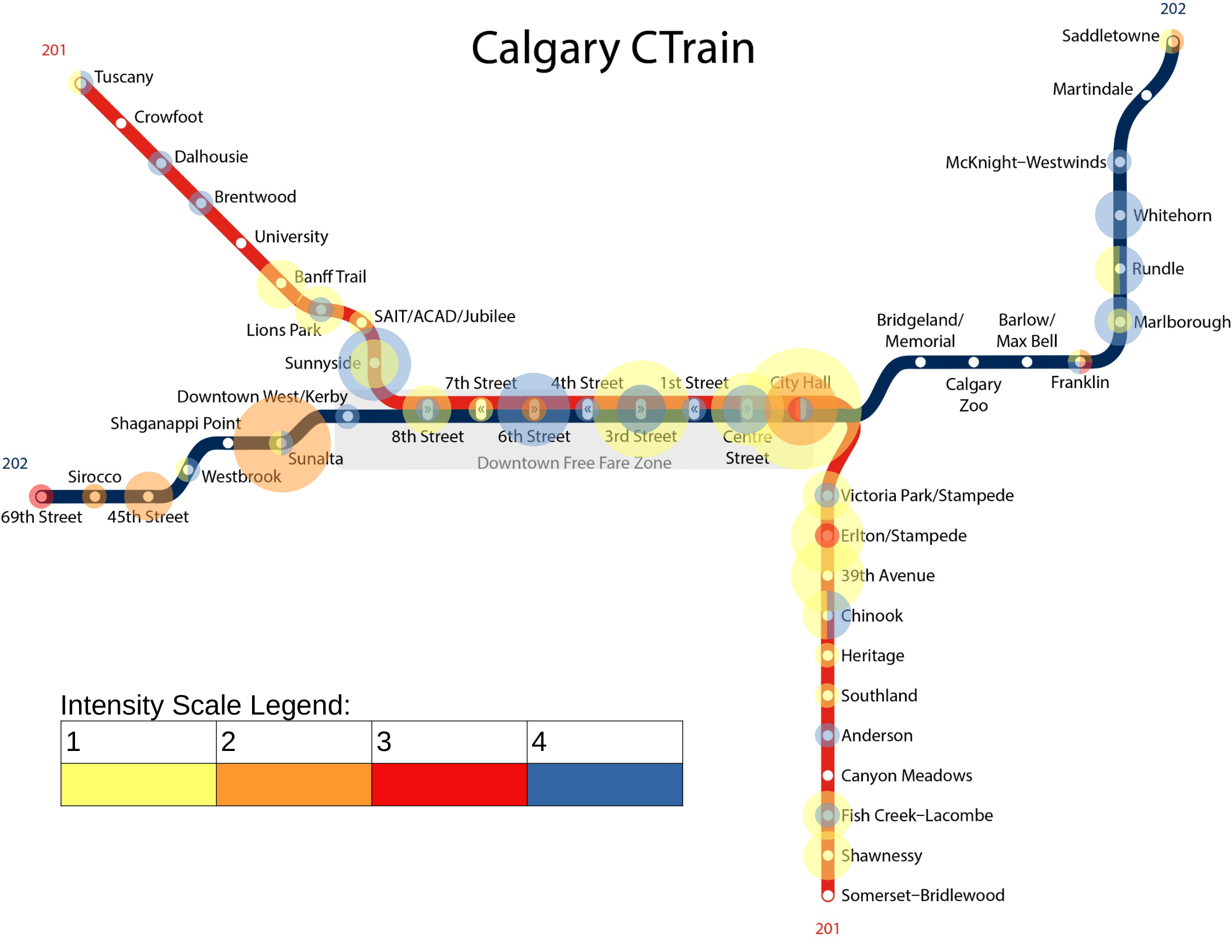
Note. Yellow represents a minor conflict, orange moderate, red intense, and blue a mitigating factor. Adapted from “Calgary Ctrain Map,” by T. Verhey. (2013).(https://commons.wikimedia.org/wiki/File:Calgary_CTrain_Map.png) CC BY-SA.

Data Analysis & Discussion
The data collected opens many interesting avenues of research. I would like to approach this data with a risk society lens, first defined by Ulrich Beck (1992) then further developed by Loïc Wacquant (2008), and Kelly Hannah-Moffat (2005).
Risk Society
A risk society is described as one that has three main factors: the shift of focus towards the distribution and management of “risk” in a society, a renewed importance placed upon the ideals of individualism, and a de-standardization of labor that results in career instability and uncertainty (Beck, 1992, as cited in Jong, 2022). Wacquant develops this and argues that the destabilization of labor disproportionately affects the lower class, leading this population to bear the burden of risk in greater quantities than those who make up the middle and upper classes. This distribution of risk provided governments and administrative agencies justification for increasing policing, security, and surveillance within these groups. By considering crime a problem of risk distribution as opposed to an issue stemming from individual malfeasances a risk society approach to crime supposedly allows for a more objective method of identifying which groups or areas need higher levels of policing—sometimes called “hotspot” policing. Hannah-Moffat notes that this shift towards risk is appealing as “the morally neutral scientific actuarial terminology of risk disguises the condemnatory pariahdom created by classifications” (Hudson, 2004 as cited in Hannah-Moffat, 2005, p. 36).
This morally neutral language is identified and promoted by a propensity to appeal towards statistical indicators of social conflict that identify certain groups, individuals, or places as having certain characteristics that make them more or less likely to experience or to perpetuate social conflict. Common examples are that being in a dark, downtown area late at night could increase your risk of experiencing conflict, or that individuals suffering from poverty are at a higher risk of participating in social conflict. This can also be seen in contemporary discourse with the marked shift away from older criminogenic labels such as “delinquents” and “vagrants” to the more commonly adopted moniker of “at-risk individuals” to refer to those who are young, homeless, or struggling with poverty or addiction.
Actuarial, risk-focused terminology is commonly used to describe aspects of Calgary’s LRT system such as some LRT stations being more “risky” than others. However, the shift towards an actuarial understanding of crime is not the only aspect of risk society theories we can see present in discourse surrounding transit. According to Wacquant these risk-based polices all share features with each other, the first of which being that “they purport to put an end to the ‘era of leniency’ and to attack head-on the problem of crime, as well as urban disorders and the public nuisances bordering the confines of penal law, baptized ‘incivilities,’” (Wacquant, 2008, p. 10). A “tough on crime approach” is commonly touted as the strongest and most direct way to deal with social conflict on the transit system. This idea is reflected in the marked increase in sightings of police and peace officers, as well as station security guards, during the data collection period of this study. Nearly 1/3 of data points collected were mitigatory factors. As per the Calgary Public Transit Safety Strategy more officers were being trained and put onto the transit stations and new safety hubs were being built in high risk areas to reduce response times and to have more officer presence—a policy that, while in motion for a few years, happened to overlap well with this study. In their report the City of Calgary speaks to its goal of mitigating conflict by managing risk effectively (City of Calgary, n.d.-a). The report also proposes locations for new safety hubs, presumably in locations identified to be of higher risk. Identifying these hotspots and using that information to justify increases in policing in those areas is exactly the kind of risk focused understanding discussed in risk society theories of crime; the focus is on the risk specific individuals pose to the transit system. It is worth noting that the locations of the proposed and existing safety hubs reflect similar groupings of social conflict as shown in Figure 1.
Figure 2
Integrated response district model
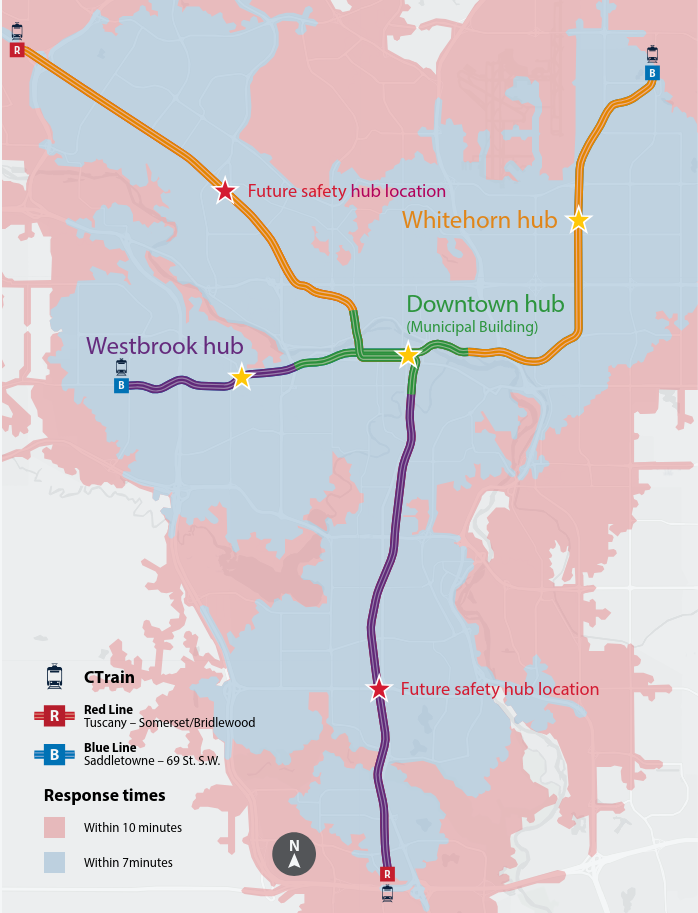
By City of Calgary, n.d -a. (https://www.calgary.ca/safety/transit-safety.html)
The language used surrounding these improvements to safety on the Calgary transit system reflect the more static approach to risk that Beck and Wacquant discuss in which social conflict is treated as being resultant of a general risk level, whether the result of peoples or location. However, this static approach deliberately disregards the underlying cause of social conflicts that occur within those “risky” groups or areas (Wacquant, 2008, p. 10). Kelly Hannah-Moffat (2005) also notes that “the tendency to generalize risk management as a common feature of modern societies overlooks the specificity of particular constructions, histories, and applications of the term risk in a given social context.” (p. 44). This leads to a major pitfall of these theories: more policing, surveillance, and punishment of those “risky” groups does not prevent conflict. Instead, it provides a framework to clean up incidences of conflict and shore it away to places where others will be “guarded” from risk, without addressing those factors—such as social exclusion—which pushes individuals to create conflict in the first place. This static approach, while certainly useful in responding to incidences of conflict and making people feel safer on transit due to increased police presence, cannot effectively prevent future conflict from happening.
In order to effectively manage risk the underlying causes of conflict must be addressed.
In doing so we can look further into Kelly Hannah-Moffat’s refinement of the concept of risk and the transformative risk subject.
Dynamic Risk and the Transformative Risk Subject
Limited by static conceptions the understanding of risk underwent a shift from static to dynamic. Kelly Hannah-Moffat discusses this shift as an understanding that offenders have the ability and potential to change certain factors that affect their rates of recidivism. These malleable factors (such as substance use and employment) are then conceptualized as criminogenic risk factors/criminogenic needs—“dynamic attributes of an offender that, when changed, are associated with changes in the probability of recidivism” (Hannah-Moffat, 2005, p. 39). Subjects possessing the ability to change is a fundamental principle of all rehabilitative policies. For example, in many instances of modern rhetoric surrounding criminal justice in Canada the justice system aims to rehabilitate offenders when possible in lieu of strict punishment, therefore presupposing the idea that these individuals can in fact change should certain criteria be met. Hannah-Moffat takes the idea of criminogenic risk and develops from it the transformative risk subject—an offender with dynamic (criminogenic) risk factors that is amenable to targeted intervention and who can become a prudent and rational risk managing subject, should their individual criminogenic needs be met (Hannah-Moffat, 2005, p. 31).
This understanding of criminal offenders offers two advantages, it reaffirms the dignity of individuals by recognizing their autonomy and ability to ameliorate their situation(s) should their criminogenic needs be met and it “is more compatible with correctional projects that remain concerned about the reintegration of offenders” (Hannah-Moffat, 2005, p. 34). This theory provides not only an explanation for why some individuals commit crime—an individual need is not being met—while also providing an avenue of rehabilitation for those offenders—determine their individual needs and find ways to meet them in an acceptable manner. By meeting an offender’s criminogenic needs their dynamic risk level would go down which should result in individuals who are less likely to become actors in instances of social conflict.
Some may critique this view by stating it is infeasible to meet every need every individual (transformative risk subject) expresses. This critique is answered by narrowing the scope of what is considered a criminogenic risk factor. Not only is a criminogenic risk factor something that is statistically significant in relation to recidivism, but it also must be a risk factor that can be acted upon, determined by the availability of resources and structural arrangements in a society (Hannah-Moffat, 2005, p. 39). Factors that are related to recidivism but not able to be addressed under the current social structure are not considered criminogenic risk factors/needs.
After narrowing the scope of what constitutes a criminogenic risk factor it may be difficult to determine which needs are in fact criminogenic for each offender; a more traditional, punitive approach would seem to be much more efficient. However, this may not be as problematic when looking at transit conflict. Reports from both Calgary and Edmonton’s transit systems found that a relatively small number of people are committing a disproportionately large number of conflicts (Lindsay et al., 2025; Lindsay et al., 2026). In light of this information the consideration of criminogenic need/dynamic risk seems even more appropriate as the pool of transit offenders shrinks from public perception and the potentially time consuming process of determining criminogenic needs for individuals can be more effectively applied to those repeat offenders on the transit system.
Finding this information also affirms an interesting personal anecdote that occurred during the course of this ethnography: There were multiple instances in which I recognized individuals whom I had recorded as participating in social conflict on previous days. If most social conflict on transit is perpetuated by a small group of repeat offenders, perhaps it would be best to divert resources towards determining who those individuals are and what are their criminogenic needs that we can address. This method of risk management would be much more proactive than simply putting resources toward cleanup and after-the-fact management of social conflict in certain areas along the LRT system.
The Decoupling of Risk From the Individual
While the above conception of the transformative risk subject helps justify a shift away from punitive policies to rehabilitative ones, it cannot entirely function as a method of reducing recidivism rates due to the narrow manner in which it identifies criminogenic risks: a risk causally linked to recidivism which is able to addressed within the current social structure. Hannah-Moffat argues this limited conception "cannot adequately account for complex changes, agency, and changes over the life course [of an offender] (Hannah-Moffat, 2016, p. 36). Not only does this limited conception not allow for the interpretation of individuals needs as criminogenic needs if we as a society are unable to meet those needs effectively, it continues to entrench the onus of change upon the individual. When criminogenic needs focus solely on an individual's ability to change their circumstances over time, albeit with the necessary supports from social services, it precludes the ability that there are factors outside their control that could be changed that would affect their rates of recidivism. As Hannah-Moffat states: "current conceptualizations of dynamic risk [criminogenic risk] are unavoidably disconnected from wider social processes and contexts, and ensure the an offender's needs are distinct" (Hannah-Moffat, 2016, p. 39). Many offender populations share criminogenic risk factors that—should we desire to effectively treat root causes of crime—must be answered by changing structures, not just individual circumstances. Only by decoupling the idea of criminogenic risk from the individual and considering it in a wider context can these benefits be seen.
An increasing body of literature has identified the ways in which structural and systemic factors affect individuals propensity to participate in social conflict. Structural inequalities or blind spots also contribute to systemic discrimination and over-representation of certain groups of individuals in the justice system therefore increasing their chances of recidivism by actively pushing them towards social conflict by way of societal organization. It seems folly to consider criminogenic risk factors only those factors that can be change by the individual transformative risk subjects themselves. There exist structural and systemic factors that are clearly linked to rates of recidivism that could be changed (just not by the individual themselves) that should also be viewed as criminological risk factors. Disentangling the notion of criminogenic risk away from the individual allows for a wider consideration of what factors contribute to social conflict allowing us to "reveal how unmet needs can affect pathways into crime" (Hannah-Moffat, 2016, p. 37).
Non-individual Criminogenic Risk Factors Preset in the Data
Looking at the collected data we see that mitigating factors constitute nearly 1/3 of all activities identified. This fact is integral to this paper’s argument as it demonstrates a clear lack in the ability for a risk society understanding of conflict to effectively mitigate conflict on the trains. Identifying conflict hotspots and increasing policing in those areas may be useful to mitigate feelings of insecurity and improve response times, but it does not effectively complete the underlying goal of these programs: preventing conflict. The system is inherently reactive and any proactive efforts will by stymied by a conception of risk that only looks at individuals as standalone risk factors. Thus, as advocated above, a decoupling of risk from the individual must be had so as to understand what moves individuals into conflict pathways and how we can support them before conflict occurs, not after.
If we look at the collected data with a lens that decouples risk factors from individual actors and instead looks towards shared needs, I believe the data presents an argument for providing more robust systemic support for individuals struggling with drug addiction. In the data public drug use constituted 11% of all activities recorded, and 17% of all instances of conflict recorded (determined by excluding mitigatory factors in the calculation). For such a short period of study it is interesting to note that almost 1/5 of conflicts involved some sort of drug use. Through a complex interrelation drug use and abuse has historically been shown to act as an aggravating factors against rehabilitation, which perpetuates itself through chronic stress and poverty, which individuals experience by way of social exclusion and prejudice (Hakansson & Berglund, 2012; Sudip & Amarjeet, 2021; Sinha, 2008; Cole et al., 2011). With a decoupled conception of criminogenic risk factors a shared need for fulsome support for those dealing with drug abuse would indeed constitute a criminogenic need. If more focus was put towards identifying these shared criminogenic needs it could help reduce one of the largest individual categories of social conflict on transit and could potentially indirectly reduce other instances of conflict as well. A further inquiry into why current supports for drug abuse are not sufficient to meet this need may be had in the future.
While considering these shared needs, care must be taken; a clear, objective determination of what does and does not count as a criminogenic need (the need statistically affects recidivism and the need can be met) makes the process of identifying these needs much easier, however, it cannot account for all the complex factors that affect individual's pathways into social conflict. There will inevitably be avenues of amelioration that will be missed should this method be understood to be a monolithic solution to addressing social conflict. I suspect also that this outcome-driven approach is favored due to the surrounding actuarial nature of risk theories themselves. This method, while useful in some respects, does introduce the possibility that in determining which needs are criminogenic needs statistical data is used that misrepresents or disproportionately represents certain factors as being more or less likely to contribute to recidivism. This is a common narrative in indigenous studies in which studies preformed with a colonial lens fail to accurately understand the reasons, causes, or solutions of hardships for these groups. If Hannah-Moffat’s approach is to be taken, one must be incredibly diligent to ensure that the criminogenic needs identified are justified by research that accurately represents the struggles of those involved, shared and individual. This may of course be difficult in certain scenarios, and impossible in others, but to do otherwise would be to ignore the historical and societal misgivings perpetrated by poor research practices. In addition, the necessity that a criminogenic need is described as such only if a society is able to effectively address said need is also potentially problematic. There are some needs that a society may not be structurally prepared to meet, however, I do not think this should lead to the conclusion that this factor is not then considered a need. If there is a need which we cannot meet, but that would ameliorate an offender’s likelihood of recidivism if it were met, I suggest that in these situations we should consider why it is that society is not structured to meet this need. A need not met should not be a defeat, but an avenue for future changes and improvements to increase the welfare of all.
Reflexivity Statement
The last thing I would like to touch on is the following quote from Kelly Hannah-Moffat’s paper: “Offender populations routinely are subdivided, categorized, and classified according to levels of risk (i.e. high, medium, or low).” (Hannah-Moffat, 2005, p. 30). She states this during her descriptions of more static risk society theories that generally shift the focus of risk management away from individualized rehabilitative practices towards generic actuarial models of population management. I strongly believe in the benefits and goals of rehabilitation and thus have argued for considering the more dynamic approach to risk in this paper. However, this statement struck me when I first read it as I realized that subdividing, categorizing, and classifying offenders according to risk is was exactly what I did to members of my city during this study. I was unaware of how deeply ingrained ideologies of risk are within me, so much so that I was unable to notice how my actions contributed to this static understanding until it was quite literally in front of my face. It was not my intent to reduce these individuals down to a single number, nor was it my intent to promote an approach to conflict management that reflected a static, actuarial approach.
Though I have advocated for a more fulsome approach to supporting those who are struggling with drug abuse, I would like to speak highly towards the efforts already enacted in the transit system, specifically the influx of new peace and police officers patrolling transit stations. I can say anecdotally that the decision was beneficial. This is not to say that the presence of these officers reduced or prevented conflict, though it may have had that effect to some extent, but the feeling of security instilled within me as someone who, until now, had not used transit regularly was greatly appreciated. In addition I noticed a very quick response time to incidences of conflict, and officers were very pleasant and helpful when asked directions or other questions.
This study was informative, difficult, and very interesting. This was my first regular experience with the Calgary C-Train and on the whole I can honestly say I was impressed. The trains came regularly, moved quickly, and were generally well kept. The stations themselves were quite pleasant, with many wind blockers and heated areas present to keep me warm as the colder weather came in. While I was hopeful there would be no conflict on the LRT, I was not naive. I knew I would experience conflict firsthand and did so on many occasions. In the end I believe that I have produced a useful dataset that can be used in future studies and presented a strong argument for the necessity of individualized rehabilitative approaches to conflict management.
Conclusion
Five weeks of study on the Calgary LRT system led to 97 recorded instances of conflict over 10 distinct categories. When viewed with a contemporary lens that shifts the onus of change away from individuals to focus on structural criminogenic risk factors we see a need for increased support for those suffering from drug addiction. Shifting this lens is necessary for continued reflection refinement of the ways in which societal structures affect individual’s propensity to participate in social conflict.
References
Verhey, T. (2013). Calgary Ctrain Map. https://commons.wikimedia.org/wiki/File:Calgary_CTrain_Map.png
Beck, U. (1992). Risk society: Towards a new modernity. SAGE.
Stolte, E. (2024). New report blames transit safety problems on gaps in Calgary’s shelter system. CBC. https://www.cbc.ca/news/canada/calgary/transit-calgary-vcc-homeless-1.7214161
Keiller, J. & Lindsay, B. (2025). Violent crime up nearly 60% on Calgary transit over past decade. Police chief calls it ‘very concerning’. CBC. https://www.cbc.ca/news/canada/calgary/violent-crime-up-nearly-60-on-calgary-transit-over-past-decade-police-chief-calls-it-very-concerning-9.6993426
Kaufmann, B. (2024). Calgarians’ concerns over homelessness, transit safety rise; fear of violent crime down: Survey. Calgary Herald. https://calgaryherald.com/news/local-news/calgarians-concerns-homelessness-transit-safety-rise-survey
Beimborn, E., Horowitz, A., Schuetz, J., Zejun, G. (1993). Measurement of transit benefits: Final report (Publication No. WI-11-0013-1). U.S. Department of Transportation. https://rosap.ntl.bts.gov/view/dot/13827/dot_13827_DS1.pdf
Brantingham, P. J., Brantingham P. L., & Andresen, M. A. (2016). Environmental Criminology and Crime Analysis. In R. Wortley & M. Townsley (Eds.), The geometry of crime and crime pattern theory (2nd ed.). Routledge
Calgary Police Commission. (2025). Community perceptions. Illumina Research Partners. https://www.calgarypolicecommission.ca/wp-content/uploads/2025/06/June-2025-CPC-7.1-2025-Community-Perceptions-Report-Safety-Policing-Public-Priorities-for-Public-Distribution.pdf
Calgary Transit (n.d.). Statistics. https://web.archive.org/web/20170617013846/http://www.calgarytransit.com/about-us/facts-and-figures/statistics
City of Calgary. (n.d.-a). The Public Transit Safety Strategy. Retrieved February 12, 2026, from https://www.calgary.ca/safety/transit-safety.html
City of Calgary. (n.d.-b). Yearly ridership. Retrieved November 15, 2025, from https://data.calgary.ca/Transportation-Transit/Yearly-Ridership-current-year-is-year-to-date-/n9it-gzsq
Cole, J., Logan, T. K., & Walker, R. (2011). Social exclusion, personal control, self-regulation, and stress among substance abuse treatment clients. Drug and Alcohol Dependence, 113(1), 13-20. https://doi.org/10.1016/j.drugalcdep.2010.06.018
Community Standard Bylaw, City of Calgary By-law 32M2023.
Criminal Code, R.S.C. (1985) c. C-46, s. 264.
Falvo, N., Stevens, L., Penich, T. (2024). No place to go: Examining homelessness and social disorder as it relates to public transit in Calgary. Vibrant Communities Calgary. https://enoughforall.cdn.prismic.io/enoughforall/ZliwNKWtHYXtT8UK_NoPlaceToGo_PrintableVersion.pdf
Gibson, T. A. (2005). NIMBY and the civic good. City & Community, 4(4), 381-401. https://doi.org/10.1111/j.1540-6040.2005.00144.x
Hakansson, A. & Berglund, M. (2012). Risk factors for criminal recidivism—a prospective follow-up study in prisoners with substance abuse. BMC Psychiatry, 12(111). https://doi.org/10.1186/1471-244X-12-111
Hannah-Moffat, K. (2005). Criminogenic needs and the transformative risk subject: Hybridizations of risk/need in penality. Punishment & Society, 7(1), 29-51. https://doi.org/10.1177/1462474505048132
Hannah-Moffat, K. (2016). A conceptual kaleidoscope: Contemplating ‘dynamic structural risk’ and an uncoupling of risk from need. Psychology, Crime & law, 22(1-2), 33-46. https://doi.org/10.1080/1068316X.2015.1114115
Hilker, L., Fraser, E. (2009). Youth exclusion, violence, conflict and fragile states. DFID Equity and Rights Team. https://linkasea.pbworks.com/f/McLean+Kilker,+Lyndsay+&+Erika+Fraser+April+2009.pdf
Jong, A. (2022). World risk society and constructing cosmopolitan realities: A bourdieusian critique of risk society. Frontiers in Sociology, 7, Article 797321. https://doi.org/10.3389/fsoc.2022.797321
Kapatsila, B. & Grisé, E. (2025). An empirical investigation of the impact of preferences for physical, social, and security factors on the feeling of safety on public transit. Transportation Research Part A: Policy and Practice, 196, Article 104501. https://doi.org/10.1016/j.tra.2025.104501
Knowles, R. (2006). Transport shaping space: differential collapse in time-space. Journal of Transport Geography, 14(6), 407-425. https://doi.org/10.1016/j.jtrangeo.2006.07.001
Lindsay, B., Szeto, E., Sheldon, M., & Frew, N. (2026). ‘Frequent flyers’ behind surge in violence on public transit. CBC. https://www.cbc.ca/news/canada/transit-crime-edmonton-repeat-offenders-9.7039643
Linsday, B., Szeto, E., & Sheldon, M. (2025). Transit violence rising across Canada—in some cities by nearly 300%. CBC. https://www.cbc.ca/news/canada/transit-crimes-canada-9.6991533
Mack, R., & Snyder, R. (1957). The analysis of social conflict—toward an overview and synthesis. Journal of Conflict Resolution, 1(2), 212-248. https://doi.org/10.1177/002200275700100208
Panhandling Bylaw, City of Calgary By-law 3M99.
Prommaharaj, P., Phithakkltnukoon, S., Demissle, M. G., Kattan, L., Ratti, C. (2020). Visualizing public transit system operation with GTFS data: A case study of Calgary, Canada. Heliyon, 6(4), e03729. https://doi.org/10.1016/j.heliyon.2020.e03729
Public Behviour Bylaw, City of Calgary By-law 54M2006.
Scott, C., & Medaugh, M. (2017). Types of Observers. The International Encyclopedia of Communication Research Methods, 1-5.
Sinha, R. (2008). Chronic stress, drug use, and vulnerability to addiction. Annals of the New York Academy of Sciences, 1145(1), 105-130. https://doi.org/10.1196/annals.1441.030
Statistics Canada. (2025a). Table 35-10-0026-01 Crime severity index and weighted clearance rates, Canada, provinces, territories and Census Metropolitan Areas. [Data table]. https://www150.statcan.gc.ca/t1/tbl1/en/cv.action?pid=3510002601
Statistics Canada. (2025b). Table 35-10-0177-01 Incident-based crime statistics, by detailed violations, Canada, provinces, territories, Census Metropolitan Areas and Canadian Forces Military Police. [Data table]. https://www150.statcan.gc.ca/t1/tbl1/en/tv.action?pid=3510017701
Stewart, F., Barron, M., Brown, G., Hartwell, M. (2006). Social exclusion and conflict: Analysis and policy implications. Centre for Research on Inequality, Human Security and Ethnicity. https://assets.publishing.service.gov.uk/media/57a08c4640f0b649740010f0/policypaper.pdf
Street Bylaw, City of Calgary By-law 20M88.
Sudip, B. & Amarjeet, S. (2021). Poverty, gambling, and illicit drug use perpetuate each other in a bidirectional cycle: An analysis from a case study. Journal of Applied Sciences and Clinical Practice, 2(1), 26-29.
University of Manitoba. (2021). Public transit and equity-deserving groups: Understanding lived experiences. http://hdl.handle.net/1993/36137
Vuchic, V. (2007). Urban transit systems and technology. John Wiley & Sons, Inc.
Wacquant, L. (2008). Ordering insecurity: Social polarization and the punitive upsurge. Radical Philosophy Review, 11(1), 9-27.